
TL;DR: Choosing a cloud ERP in Saudi Arabia comes down to three checks most buyers skip: whether the system is genuinely ready for ZATCA Phase 2 integration, how the price changes as you add users, and what the total cost looks like over three years. This checklist gives Saudi SMEs 25 questions to put to any vendor, a pricing-model comparison, and a 3-year cost formula.
Last updated: 18 October 2026
Why the ERP decision matters more for Saudi SMEs in 2026
For Saudi SMEs, 2026 is the year e-invoicing integration reached smaller businesses, and the cost of choosing the wrong system went up with it. Three forces are behind that shift.
First, the scale of the segment. According to Monsha'at, the General Authority for Small and Medium Enterprises, Saudi Arabia had around 1.27 million SMEs in Q3 2023, up 3.5%. Vision 2030 targets raising the SME share of GDP to 35%, as Arab News reported. That growth puts pressure on owners to run operations on systems rather than spreadsheets.
Second, compliance. ZATCA, the Zakat, Tax and Customs Authority, is onboarding businesses to Phase 2 e-invoicing in waves. The Wave 25 announcement covers businesses whose VAT-taxable revenue exceeded SAR 187,500 in any year from 2022 to 2025, with integration starting 1 February 2027. According to VATupdate, that threshold is half the SAR 375,000 used for Wave 24.
Third, the cost of overruns. Panorama Consulting's 2026 research, summarised by ERP Statistics, found that 30% of ERP projects went over budget. For a small business, an overrun can wipe out the savings the system was meant to deliver.
Check 1: Is the ERP genuinely ready for ZATCA Phase 2?
"ZATCA compliant" on a sales page is not enough; Phase 2 means the ERP must integrate directly with ZATCA's Fatoora platform and meet a specific set of technical requirements. Phase 1 was about generating invoices electronically. Phase 2 is about connecting your system to the tax authority.
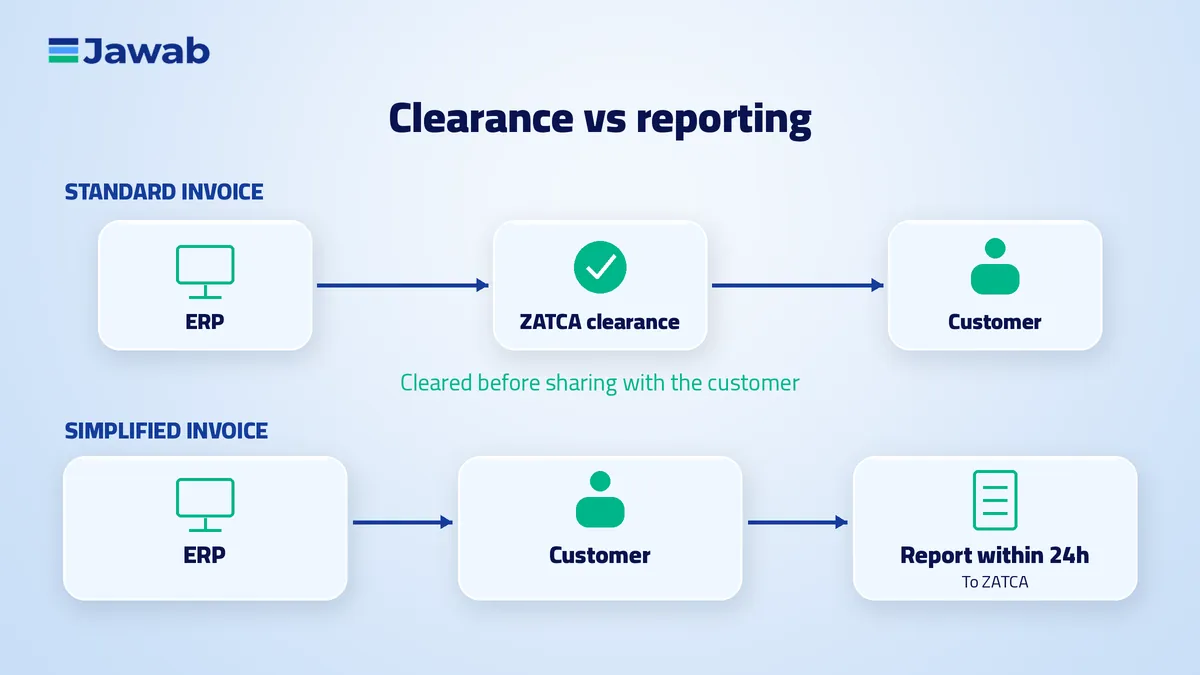
Under Phase 2, invoices follow one of two flows, as set out in ZATCA's Detailed Technical Guideline:
- Clearance for standard tax invoices (B2B and B2G): the invoice must be cleared by ZATCA before it is shared with the buyer.
- Reporting for simplified tax invoices (B2C): the invoice goes to the customer immediately and is reported to ZATCA within 24 hours.
The technical requirements in the same guideline include:
- A Cryptographic Stamp Identifier (CSID), obtained through a certificate signing request and a one-time password, first as a compliance CSID for testing and then as a production CSID.
- Invoices generated as XML following the UBL 2.1 standard.
- A cryptographic stamp on every invoice.
- A unique identifier (UUID) for each invoice.
- A hash chain linking each invoice to the previous one.
- A QR code carrying the required invoice data.
Questions to ask the vendor
- Is the system onboarded and tested on Fatoora for Phase 2?
- Does it generate both standard and simplified invoices in UBL 2.1 XML?
- Does it clear standard invoices automatically before they reach the customer?
- Does it report simplified invoices automatically within 24 hours?
- Does it support credit and debit notes linked to the original invoice?
- Does each branch or point of sale get its own CSID?
- Does it show each invoice's status (accepted, rejected, accepted with warnings) and the rejection reason?
- Is Phase 2 integration included in the subscription, or sold as an add-on?
If the answer to any of the first four is "no", the system is not ready for Phase 2, whatever the marketing says.
Check 2: How does the price change as you add users?
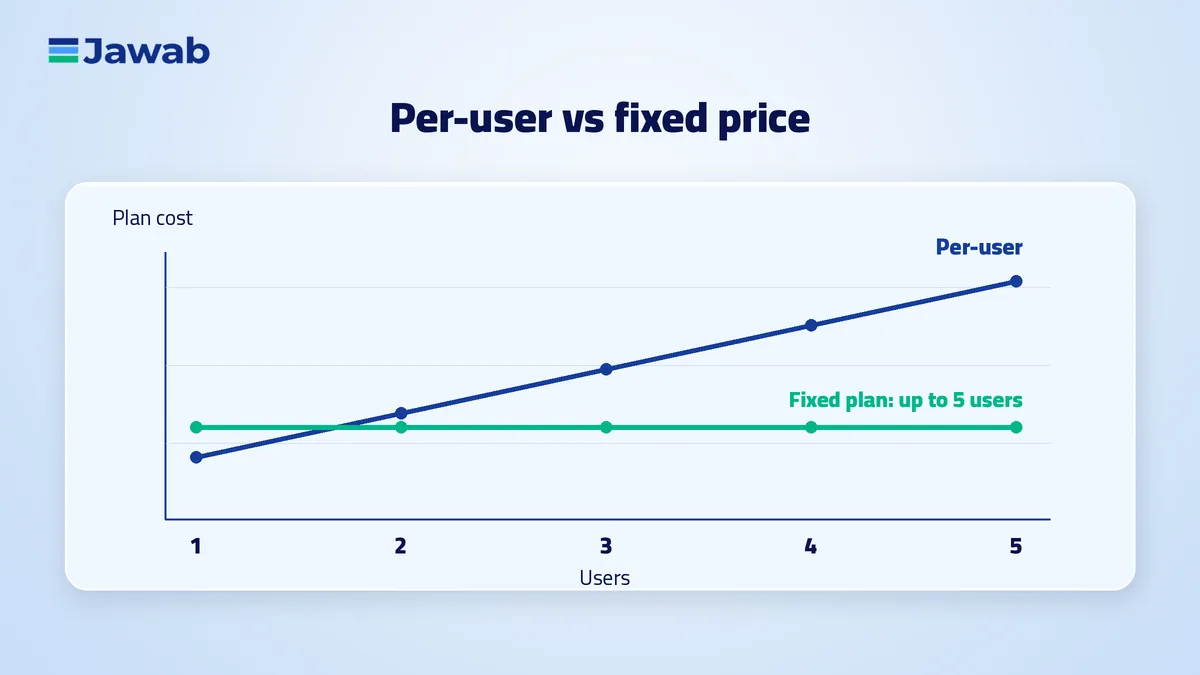
The pricing model decides how your ERP bill grows with your business, and it matters more than the starting price. Two common models in the Saudi market behave very differently once you hire.
| Per-user licence + implementation partner | Fixed-price cloud plan | |
|---|---|---|
| How you pay | A fee per user, monthly or yearly | One subscription covering a set number of users |
| Implementation | A project with a partner, billed separately | Self-service setup on standard settings |
| Time to go live | Weeks to months, depending on scope | Account activated the same day; full go-live in a few weeks |
| Effect of hiring | Cost rises with every user | Flat up to the included limit, then a per-user fee |
| Customisation | Very flexible, usually billed by the hour | Limited to what the system offers |
| ZATCA Phase 2 | Depends on the product and partner | Included in some plans |
| Best fit | Large firms with complex operations | SMEs that want a predictable cost |
Neither model is right for everyone. A manufacturer with hundreds of users and complex supply chains may need the flexibility of per-user licensing and a partner. A five-person trading company usually needs a system it can activate the same day and run fully within a few weeks, at a known price.
Questions to ask the vendor
- How many users does the quoted price include?
- What is the fee for each additional user?
- What does adding a branch or warehouse cost?
- Does the plan change automatically when you pass a user or revenue threshold?
- Is there a discount for annual billing, and what happens if you switch to monthly?
Check 3: What is the total cost over three years?
Comparing licence prices alone is one common way ERP budgets go wrong; compare total cost of ownership over three years, for the same number of users, for every quote. Panorama's research found that, among over-budget projects, the top causes were unplanned technology needs (54.9%) and scope expansion (51.0%), according to ERP Statistics. Both show up as costs that were never in the original quote.
The 3-year formula
3-year total cost = (subscription or licences × 3) + implementation + customisation and integrations + training + (support and maintenance × 3) + ZATCA integration if not included + expected additional users
Worked example: a 5-user business
Take a trading business with five staff who need sales, purchasing, inventory, accounting and ZATCA e-invoicing.
- Per-user model: multiply the per-user price by 5, then by 12 months, then by 3 years. Add the partner's implementation quote, training and support. Ask for every figure in writing.
- Fixed-price model: Jawab's Growth plan, for example, is SAR 2,990 per year on annual billing for up to 5 users, and includes sales, purchasing, inventory, accounting, invoicing, ZATCA Phase 2 integration, point of sale and an online store, according to its pricing page. That is SAR 8,970 over three years before any additional users.
The gap between the two models rarely shows in year one. It widens every time you add a person or a branch.
Questions to ask the vendor
- What exactly is included in the price, module by module?
- Who carries out implementation, how many hours are estimated, and at what rate?
- Who pays if implementation runs over the estimate?
- Is training included, and in what language?
- What does support cost each year, and what response times are guaranteed?
- Are data migration and integrations with your other tools priced separately?
Check 4: Where is your data hosted?
Data residency is a compliance question, not just a technical one, and it is easy to miss when buying a cloud system. According to the U.S. International Trade Administration, Saudi Arabia's cross-border data transfer rules are now enforced and require certain sensitive and personal data to be stored in the Kingdom, unless specific exemptions are granted.
An ERP holds customer names, contact details, tax numbers and transaction histories. Before signing, get clear answers.
Questions to ask the vendor
- In which country, and with which provider, is your data hosted?
- How often is data backed up, and where are the backups stored?
- Can you export all your data in a standard format if you leave?
Check 5: Will your team actually use it?
An ERP that your team avoids is a total loss, however good it looks in a demo. Usability, language and local support decide whether staff move off spreadsheets for good.
- Arabic interface and documents: invoices, reports and screens your staff and customers can read.
- A short learning curve: the team should be able to issue an invoice and check stock on the first day.
- Local support: support in Arabic, during Saudi working hours, from people who understand ZATCA.
Questions to ask the vendor
- Are the interface, invoices and reports fully available in Arabic?
- What support channels exist, in which languages, and during which hours?
- Can you trial the full system, with all modules, on your own data before you pay?
The full 25-question checklist at a glance
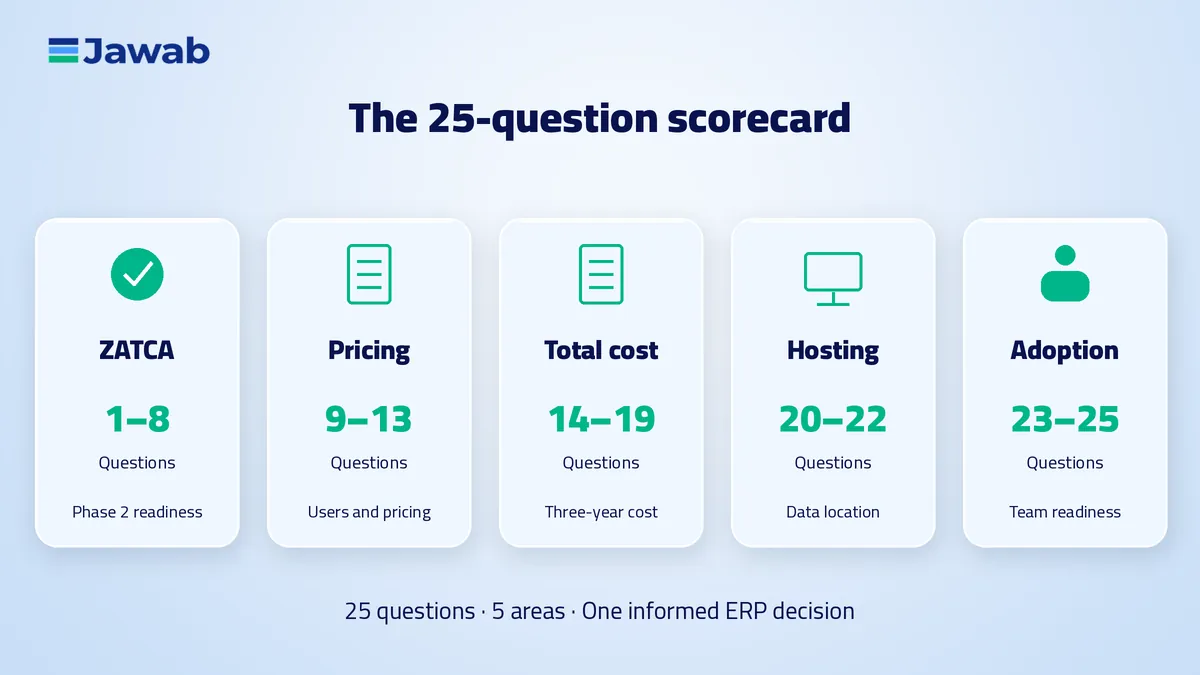
Use this summary as a scorecard: put each vendor in its own column and mark every answer as "yes", "no" or "extra cost". Any blank after a vendor meeting is a cost or a risk you have not priced yet.
| Area | Questions | What a good answer looks like |
|---|---|---|
| ZATCA Phase 2 | 1–8 | Onboarded on Fatoora, clearance and reporting automatic, included in price |
| Users and pricing | 9–13 | Clear user limit, clearly stated extra-user fee, no surprise plan changes |
| Total cost | 14–19 | Every item priced in writing, implementation risk on the vendor |
| Data hosting | 20–22 | Named hosting location, regular backups, full export available |
| Adoption | 23–25 | Full Arabic, local support hours, a full-feature trial |
Common mistakes Saudi SMEs make when buying ERP
Most costly ERP mistakes happen before the contract is signed. These are the ones we see most often:
- Buying an enterprise system for a five-person team: features you will never use, and a months-long implementation.
- Treating ZATCA as a later problem: integrating under deadline pressure costs more and carries more risk.
- Comparing licence prices only: the cheapest quote on paper often becomes the most expensive in practice.
- Customising before using: start on standard settings and customise only what real use proves necessary.
- Migrating messy data: duplicate items and customers without tax numbers carry their problems into the new system.
- Skipping the trial: signing after a slide presentation instead of testing the system on your own transactions.
For a deeper breakdown of cost items, see our Arabic guide to ERP cost in Saudi Arabia. For the Wave 25 timeline and technical steps, see our guide to ZATCA Wave 25 e-invoicing.
Where Jawab fits
Jawab is a Saudi cloud ERP built for SMEs that want ZATCA Phase 2 compliance and a predictable price in one subscription. According to its pricing page, the Growth plan covers up to 5 users for SAR 2,990 per year on annual billing, and includes sales, purchasing, inventory, accounting, invoicing, ZATCA Phase 2 integration, point of sale and an online store. The account is activated in 60 seconds.
Run the checklist on Jawab
Start a free trial and test Jawab on your own data before you decide.
- Start your free trial → https://jawab.pro/ar/pricing-plans
- Talk to sales → https://jawab.pro/ar/contactus
Frequently asked questions
What is the most important ERP requirement for Saudi SMEs? ZATCA Phase 2 e-invoicing integration. Saudi businesses are being onboarded to the Fatoora platform in waves, and Wave 25 covers VAT-registered businesses whose taxable revenue exceeded SAR 187,500 in any year from 2022 to 2025, with integration starting 1 February 2027. An ERP that cannot clear and report invoices through Fatoora will need replacing.
Is cloud ERP allowed in Saudi Arabia? Yes. Many Saudi businesses run on cloud ERP. The key question is data residency: Saudi rules on cross-border data transfer are now enforced and require certain sensitive and personal data to be stored in the Kingdom, unless specific exemptions are granted. Ask each vendor in writing where your data and your customers' data are hosted.
How much does a cloud ERP cost for a small business in Saudi Arabia? It depends on the pricing model. Per-user systems charge for every user and often add implementation fees. Fixed-price plans bundle a set number of users. For example, Jawab's Growth plan is SAR 2,990 per year on annual billing for up to 5 users, including ZATCA Phase 2 integration. Always compare total cost over three years.
What is the difference between per-user and fixed-price ERP pricing? Per-user pricing charges for every person who logs in, so cost rises with every hire, and it is often paired with a paid implementation partner. Fixed-price pricing covers a set number of users for one subscription, with a clearly stated fee for extra users. Per-user suits large, complex operations; fixed price suits SMEs that want predictable cost.
How long does it take to implement a cloud ERP? With ready-to-use cloud ERP, the account is activated the same day, and full go-live (data migration, ZATCA integration and team training) takes a few weeks. Full ERP projects take much longer: Panorama Consulting's 2026 research put the median ERP project at nine months, with almost a quarter running past their planned timeline. Scope and customisation drive most of the difference.
What modules does an SME ERP in Saudi Arabia need? Most SMEs need six: sales and quotations, purchasing, inventory, accounting and financial reports, ZATCA-compliant e-invoicing, and point of sale or an online store depending on how they sell. Manufacturing, HR and payroll, or project billing can be added later if the business needs them.
What should I ask an ERP vendor before signing? Ask what the price includes, whether ZATCA Phase 2 integration is included or extra, the fee for each additional user and branch, who handles implementation and at what cost, where data is hosted, what support is available in Arabic, and whether you can trial the full system on your own data first.
About the author: Jawab Team — the product and content team at Jawab ERP, the Saudi cloud system for sales, inventory, accounting and ZATCA-compliant e-invoicing.
Sources
- ZATCA — Wave 25 of e-invoicing integration (Arabic)
- VATupdate — ZATCA announces Wave 25, threshold halved to SAR 187,500
- ZATCA — E-Invoicing Detailed Technical Guideline
- Monsha'at — SME count, Q3 2023
- Arab News — Vision 2030 SME GDP target
- U.S. International Trade Administration — Saudi cross-border data transfer rules
- ERP Statistics — Panorama Consulting 2026 findings
- Jawab pricing page